
Mortgage Maths in Ireland: Limits, Repayments, Switching
How much an Irish lender can give you under the Central Bank limits, what repayments and Help to Buy look like in euro, and when switching pays.
By Redbison Dev · · 10 min read
Ireland edition. Written for Ireland: the Central Bank's 4 and 3.5 times income and 10% deposit limits, Help to Buy at up to €35,000 from 7 October 2026, stamp duty bands, fixed periods rolling onto variable rates, trackers and the ECB, overpayments and switching costs from the CCPC. US edition
A first-time buyer in Ireland earning €68,000 with €32,000 saved can borrow at most €272,000 within the Central Bank's limits, four times income, so the dearest home they can buy is €304,000. At an example rate of 3.65% over 30 years the repayment is €1,244.29 a month, and €175,944 of interest goes to the lender over the term. Every one of those numbers follows from a handful of rules: the Central Bank's mortgage measures, how a fixed rate rolls onto a variable one, Help to Buy, stamp duty and the cost of switching. This edition works through them in euro with the Irish mortgage calculator, the mortgage affordability calculator for Ireland and the mortgage switching calculator. It explains the maths; it is not advice about any loan, and an independent mortgage adviser can look at your own case.
How much you can borrow: two limits at once
The Central Bank's mortgage measures, in their current form since 1 January 2023, set two ceilings:
| Buyer | Loan-to-income limit | Minimum deposit |
|---|---|---|
| First-time buyer | 4 times gross income | 10% |
| Second and subsequent buyer | 3.5 times gross income | 10% |
| Buy-to-let | 30% |
The Central Bank's own example: a first-time buyer couple with a combined income of €100,000 can borrow up to €400,000; second and subsequent buyers on the same income up to €350,000. Lenders can go above the limits for 15% of first-time buyer lending, 15% of second and subsequent buyer lending and 10% of buy-to-let lending each year. The CCPC notes that switcher mortgages are exempt from both limits, although the new lender still assesses you.
Which limit binds decides what saving more will do:
- Income binds. The buyer on €68,000 with €32,000 saved can borrow €272,000, so the price tops out at €304,000; the deposit is already 10.5% of it. Saving more raises the price euro for euro, but a pay rise raises it four times faster.
- Deposit binds. With €25,000 saved, the 10% rule caps the price at €250,000 (a €225,000 loan), well under what the income would allow. Each extra €1,000 saved lifts the price by €10,000 until the income limit takes over.
The affordability calculator applies both limits and says which one is binding.
Help to Buy and stamp duty
Help to Buy refunds Irish income tax and DIRT paid in the four years before you apply, for first-time buyers of a new home. Revenue gives the amount as the lesser of:
- up to €35,000 for applications from 7 October 2026 to 31 December 2029 (it was €30,000 from 23 July 2020 to 6 October 2026);
- 10% of the purchase price of a new home, or of the approved valuation for a self-build;
- the income tax and DIRT you paid in those four years.
The home must be newly built with its construction subject to VAT, or a self-build, with a purchase price or approved valuation of €500,000 or less, and the mortgage must be at least 70% of the purchase price. On a €300,000 new home, 10% is €30,000, below the €35,000 cap, so €30,000 is the most our buyer could get, and only if they paid at least that much income tax and DIRT over the four years. The mortgage must be at least €210,000. Ask your lender how it treats the refund when it checks your deposit.
Stamp duty on residential property, for instruments executed on or after 2 October 2024, is 1% on consideration up to €1 million, 2% on any amount from €1 million to €1.5 million, and 6% above €1.5 million. On a €304,000 second-hand home that is €3,040, money you need on top of the deposit. Budget also for legal fees, which the CCPC puts at around €950 to €2,500 plus VAT, and a valuation at about €150 to €250.
The repayment, and why it moves after the fix
The repayment comes from the standard annuity formula:
M = P × r × (1 + r)^n / ((1 + r)^n − 1)

P = amount borrowed          €272,000
r = annual rate ÷ 12         0.0365 ÷ 12
n = number of repayments     360
M = €1,244.29 a month
The CCPC says mortgages usually run 20 to 35 years. Stretch the same loan to 35 years and the repayment falls to €1,147.92, €96.37 less a month, but interest rises from €175,944 to €210,125, €34,181 more.
Most lenders offer fixed periods of 2, 3 or 5 years, according to the CCPC, after which the loan moves to the lender's variable rate, which the lender sets and can change at any time. Your lender must give at least 60 days' notice before a fixed rate ends. After a three-year fix at 3.65% the balance is €256,162 with 27 years left:
| Rate after the fix | Monthly repayment | Change |
|---|---|---|
| Stay at 3.65% | €1,244.29 | |
| Variable at 4.15% | €1,315.84 | +€71.55 |
| Variable at 4.65% | €1,389.51 | +€145.22 |
The variable rates here are illustrations, not any lender's figures. Rerun the calculator with the remaining balance and term at the end of your fix, and compare a new fixed period with the variable rate before the 60 days are up.
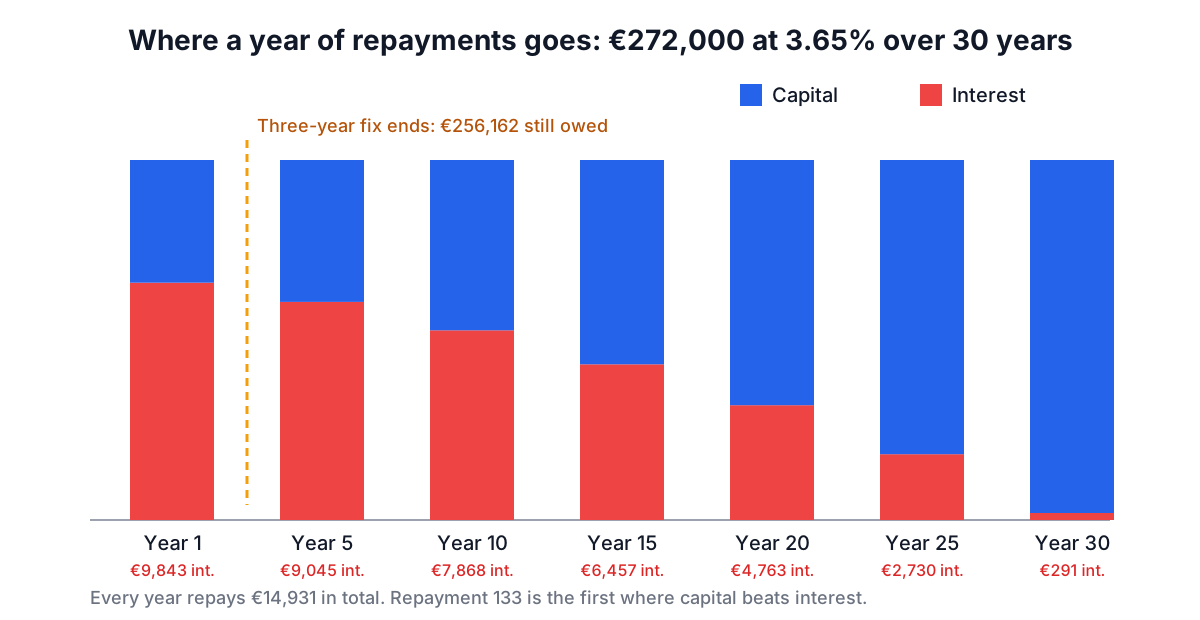
In the first year €9,843 of the €14,931 repaid is interest. Repayment 133, 11 years in, is the first where capital outweighs interest.
Trackers and the ECB
A tracker rate follows an ECB rate plus a fixed margin. The CCPC says no lender in the Irish market offers trackers to new customers, though many existing customers still have them. If you have one, remember that if you switch lender you lose the tracker permanently, and if you move from it to a fixed rate with your own lender you are unlikely to get it back. The ECB's rates from 16 September 2026 are 2.50% for the deposit facility, 2.65% for main refinancing operations and 2.90% for the marginal lending facility; your loan offer says which one your tracker follows.
Insurance and overpayments
The CCPC says buildings insurance is mandatory for all mortgages and most lenders want mortgage protection, a life policy that clears the mortgage if you die during the term, in place before they issue the loan. Add the buildings premium in the calculator's insurance field for the full monthly outlay; mortgage protection is separate.
Overpaying works differently on fixed and variable rates. On a fixed rate, the CCPC says overpaying may be limited and going beyond the limit can trigger a breakage fee; on variable rates some providers offer more flexibility, such as allowing overpayments. On the €272,000 loan, €150 a month extra from the start saves €34,825 of interest and clears the mortgage after 297 repayments, more than five years early. If you are on a fixed rate, check your terms before setting up a regular overpayment.
Switching: when it pays
Switching is the Irish word for refinancing. The CCPC's own example, Ann with €200,000 left over 20 years, moving from 4.5% to 3.5%, cuts her repayment from €1,265 to €1,160 and saves about €25,300. The switching calculator gives €1,265.30, €1,159.92 and €25,291.04 for the same figures.
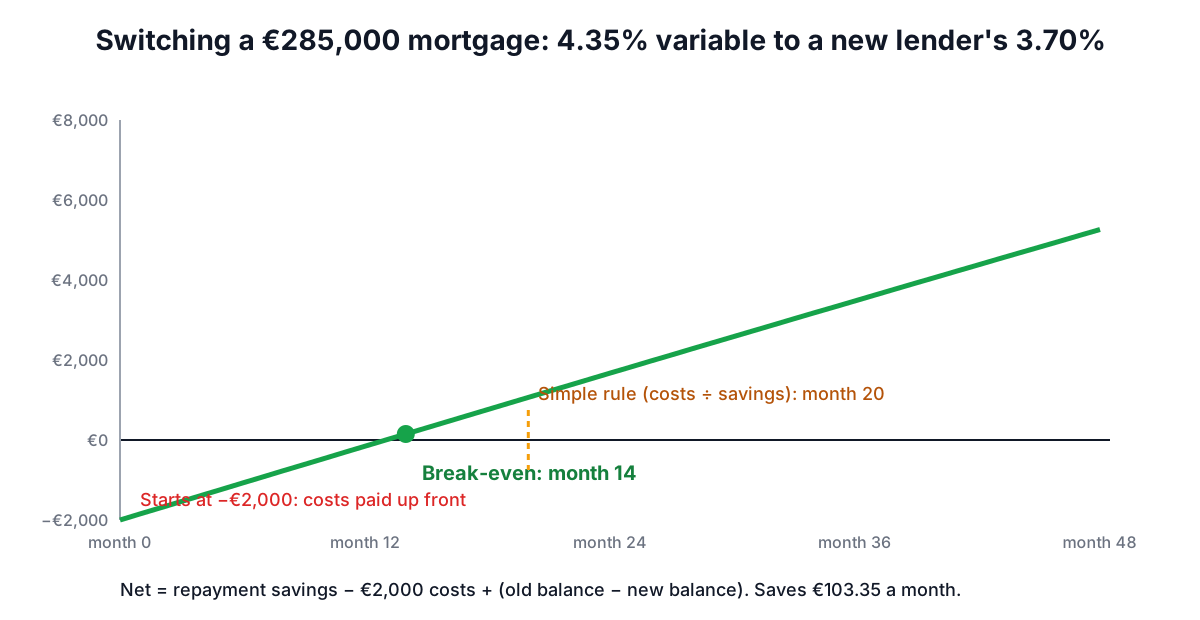
A switch has up-front costs, so the question is when the savings cover them. Take €285,000 owed with 26 years left, moving from a 4.35% variable rate to a new lender's 3.70%, with €2,000 of legal and valuation costs:
- the repayment falls from €1,526.87 to €1,423.52, a saving of €103.35 a month;
- costs divided by savings suggests month 20, but counting the faster fall in the new balance brings break-even to month 14;
- if both rates held for the full term, the switch would pay €32,244 less interest.
Leaving a fixed rate early adds a breakage fee. The CCPC gives €1,000 to €2,000 as an example for repaying €100,000 with two years of a fix left, depending on market rates; ask your lender for the exact figure in writing. The CCPC says a switch typically takes six to eight weeks.
A checklist before you sign
- Work out both Central Bank limits and which one binds you.
- Check whether Help to Buy applies, and the stamp duty, legal and valuation costs on top of the deposit.
- Reproduce the lender's repayment from the rate, amount and term.
- Price the repayment at the end of the fix with a higher variable rate.
- Read the overpayment and breakage terms of the fixed period.
- Note the date the fix ends and compare switching before the 60-day notice runs out.
The Irish guide to balance transfers and debt consolidation covers what to do with other debts before you apply.
Frequently asked questions
How much can I borrow for a mortgage in Ireland?
Up to 4 times gross income as a first-time buyer, or 3.5 times as a second or subsequent buyer, with a deposit of at least 10%, under the Central Bank's mortgage measures. A first-time buyer on €68,000 can borrow up to €272,000; lenders can exceed the limits for a share of their lending each year.
How much is Help to Buy?
For applications from 7 October 2026 to 31 December 2029, the lesser of €35,000, 10% of the purchase price of a new home and the income tax and DIRT you paid in the previous four years. The home must cost €500,000 or less and the mortgage must be at least 70% of the price.
How much stamp duty do I pay on a house in Ireland?
1% of the price up to €1 million, 2% on the part from €1 million to €1.5 million and 6% above that, for instruments executed on or after 2 October 2024. On a €304,000 home that is €3,040.
Is it worth switching mortgage for a lower rate?
When the savings cover the costs well within the time you will keep the loan. Switching €285,000 from 4.35% to 3.70% with €2,000 of costs saves €103.35 a month and breaks even in month 14. Add any breakage fee if you are leaving a fixed rate early.
Sources and further reading
- What are the mortgage measures?, Central Bank of Ireland. Income and deposit limits, allowances and the €100,000 example.
- Understanding mortgages, Competition and Consumer Protection Commission. Terms, fixed and variable rates, trackers, insurance, overpayments, breakage fees, legal and valuation costs.
- Switching your mortgage, CCPC. The switching examples, the exemption from the limits and the six to eight weeks.
- How much can you claim?, Revenue. Help to Buy amounts and dates.
- What type of property qualifies?, Revenue. The €500,000 limit, new and self-built homes and the 70% mortgage condition.
- Stamp Duty rates, Revenue. Residential rates from 2 October 2024.
- Key ECB interest rates, European Central Bank. Rates from 16 September 2026.
More Loans & Mortgages
Every tool in the Loans & Mortgages section, free and in your browser.