
NZ Home Loan Maths: Repayments, Fixing and Refinancing
Work out NZ home loan repayments monthly or fortnightly, test a re-fix at higher rates, use KiwiSaver for a deposit and check when switching banks pays.
By Redbison Dev · · 10 min read
New Zealand edition. Written for New Zealand borrowers: table loans in NZ dollars, fixed terms and re-fix risk, fortnightly repayments, the 20% deposit and low-equity costs, KiwiSaver first-home withdrawals, and switching banks at the end of a fix, using Sorted's guidance throughout. US edition
Buy an $820,000 house with a 20% deposit and you borrow $656,000. At an example rate of 5.29% over 30 years the bank's repayment is $3,638.73 a month, or $1,679.41 a fortnight, and over the full term you would pay $653,941 in interest, almost as much again as you borrowed. Those figures move with three decisions most New Zealand borrowers make more than once: how long to fix, how often to pay, and whether to stay with the bank when the fix ends. This edition works through each with the NZ home loan repayment calculator and the NZ refinance calculator. It explains the maths; it is not advice about any loan or lender, and a registered financial adviser can look at your own situation.
The table loan and its repayment
Sorted describes the table loan as the most common type of mortgage in New Zealand, and reducing loans, where the principal part stays the same, as rare. A table loan has one level repayment that clears the loan and its interest by the end of the term:
M = P × r × (1 + r)^n / ((1 + r)^n − 1)

P = amount borrowed           $656,000
r = annual rate ÷ 12          0.0529 ÷ 12
n = number of repayments      360
M = $3,638.73 a month
Council rates, house insurance and any body corporate levies are paid on top. Enter them in the calculator to see the full monthly cost of owning the house rather than just the loan.
Fixing: plan for the next rate, not this one
Sorted reports that around 86% of borrowers choose fixed rates and that two-year fixes account for nearly half of new mortgages. That means the rate in your first calculation will probably change within a few years, and Sorted's advice is to check what happens to your repayments if rates rise by 1%, 2% or more. On the $656,000 loan:
| Rate at the next re-fix | Monthly repayment | Change |
|---|---|---|
| 5.29% (today's example) | $3,638.73 | |
| 6.29% | $4,056.19 | +$417.46 |
| 7.29% | $4,492.89 | +$854.16 |
These use the full 30-year term; rerun them with the remaining term at your re-fix date. Splitting the loan between fixed and floating parts, which Sorted lists as an option, spreads that risk and lets you repay the floating part early without a break fee.
Why the balance falls so slowly at first
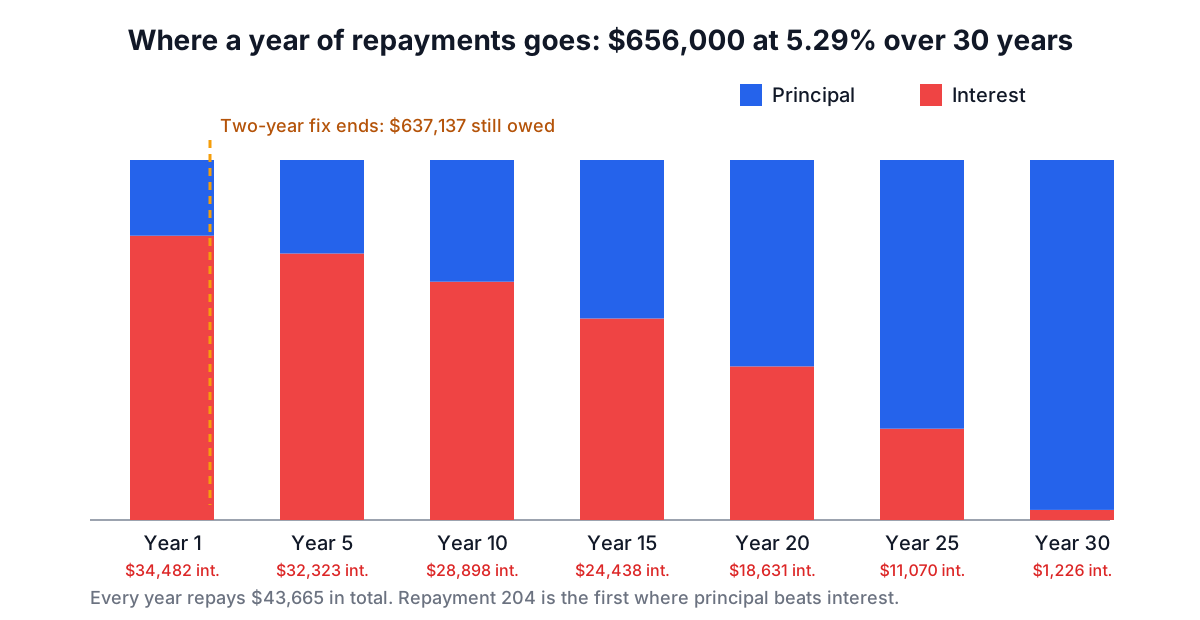
Each month the bank charges interest on the balance still owed. In the first year of the example, $34,482 of the $43,665 you repay is interest and only $9,183 reduces the loan. After a two-year fix you still owe $637,137, and repayment 204, 17 years in, is the first where principal outweighs interest.
Fortnightly repayments and paying extra
There are two ways to pay fortnightly, and they give very different results:
- The monthly amount × 12 ÷ 26, $1,679.41 a fortnight. You pay the same amount over a year, and the loan finishes about a month early, saving $3,784 of interest.
- Half the monthly amount every fortnight, $1,819.36. Because there are 26 fortnights a year, that is 13 monthly repayments instead of 12. The loan ends 5 years early and saves $127,396 of interest against monthly repayments ($123,612 more than the first method).
Sorted makes the same point and tells borrowers to ask the bank specifically for half the monthly amount, because a fortnightly figure the bank works out for you may be the first kind. Sorted's own example, $500,000 at 7% over 25 years, gives a fortnightly repayment of about $1,630 and about $560,000 of interest; the calculator gives $1,631.03 and $555,690 for the bank-style fortnightly amount, and paying half the monthly amount saves $119,018 against monthly repayments (Sorted: "close to $117,000"), ending the loan after about 20.5 years. Banks that charge interest daily get slightly different cents.
On a fixed rate, extra repayments are limited. Sorted says you can typically increase repayments somewhat without a penalty, for example up to $3,500 on a $3,000 monthly repayment, but the allowance is set by each lender. Sorted also suggests putting lump sums in just after a fixed rate ends, when there is no break fee to worry about.
Deposits, KiwiSaver and low-equity costs
Sorted says lenders generally lend up to 80% of the value or price of a house, which is why 20% is the deposit most lenders now require. Borrowing more than 80% is possible with some lenders, but they may charge a low-equity premium or mortgage indemnity insurance, and some add a margin to the interest rate. There is no separate line for this in the calculator: put a margin into the rate.
With a 10% deposit on the same house, the loan is $738,000 and the repayment $4,093.57 a month at 5.29%. An illustrative half-point margin takes it to $4,325.54, $231.97 more each month until the margin comes off. Ask each lender how it prices a loan above 80%, and when the margin ends.
KiwiSaver can fund much of a first deposit. Sorted's guide says that after three years of contributing (not necessarily in a row), at a rate of at least 3% of your income, you can typically withdraw almost all of your balance for a first home, leaving $1,000 in the account. Providers usually need about 10 working days to process it. The same guide notes that with a First Home Loan you may be able to buy with just a 5% deposit; Kāinga Ora sets the income and price limits.
How much you can borrow
Lenders assess your income, spending and other debts. Sorted gives a rough rule some commentators use: fixed payments, the mortgage plus other loans and hire purchase, should be no more than 30 to 40% of gross income. With no other debts, the $3,638.73 example needs gross household income of about $109,162 (at 40%) to $145,549 (at 30%). Sorted adds that some lenders count 70 to 80% of flatmates' rent as income, and that some banks want $750 to $1,000 a month of surplus income when you borrow 95%.
The base house affordability calculator works backwards from an income to a price if you set its debt limit to one of the percentages above and leave mortgage insurance at zero.
Refinancing at the end of a fix
For borrowers on fixed rates, the refinancing decision usually comes when a fixed term ends. Sorted's advice is to work with your existing lender or switch, whichever has the better deal, and it lists the costs of switching: break fees if you leave a fixed rate early, repayment of cash incentives from your current bank, exit or discharge fees, solicitor fees and possibly a new valuation.
Suppose your two-year fix on the example loan ends with $637,137 owing and 28 years left. Your bank offers 5.49% to re-fix; another bank offers 4.99%:
- the repayment falls from $3,716.74 to $3,523.20 a month, a saving of $193.54;
- with $1,200 of legal and discharge costs, the switch is ahead by month 5 (month 7 on the simple costs ÷ savings rule);
- if you also have to repay a $5,000 cash contribution because you are leaving within its clawback period, the costs are $6,200 and break-even moves to month 24, the length of a two-year fix.
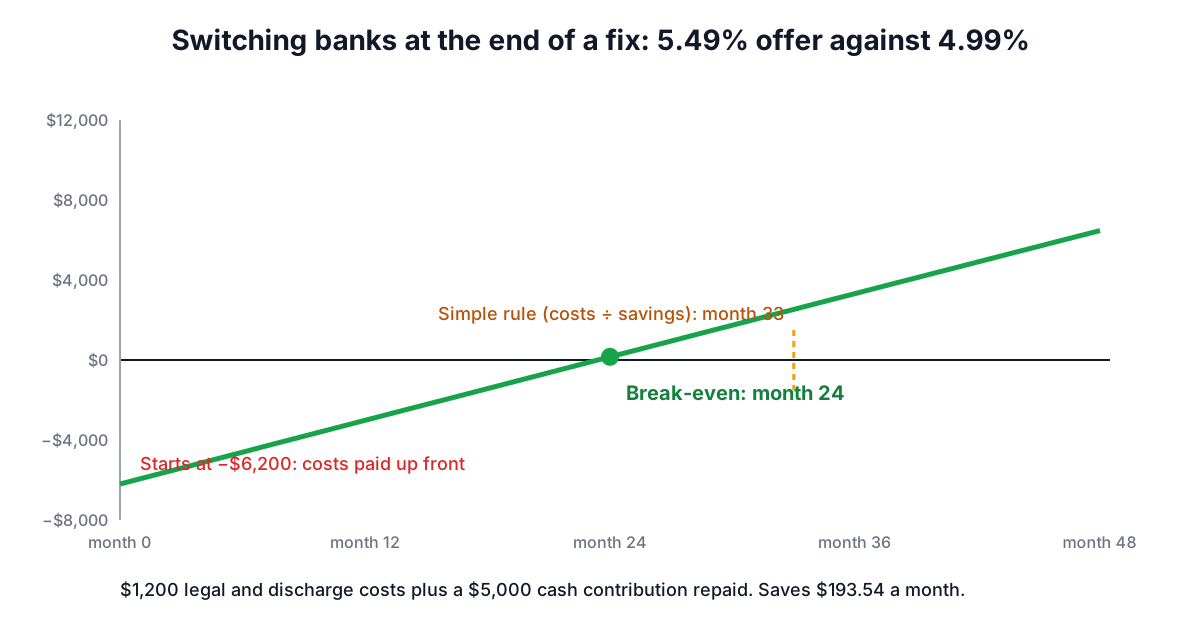
The net position counts the repayment savings, minus the costs, plus the difference between what you would owe on each loan. It reaches break-even sooner than the simple rule because the lower rate also pays the balance down faster. Before switching, ask your own bank to match the offer; it may do so with no switching costs at all. Sorted also suggests getting any break fee in writing.
Fees and the real cost
Sorted suggests asking each lender for the total cost of the loan including fees and interest, and what your yearly repayments would be at a rate 1% higher. If a lender charges an application or low-equity fee, the base APR calculator shows how much that fee adds to the effective rate over the time you expect to keep the loan.
A checklist before you fix
- Reproduce the bank's repayment from the rate, amount and term.
- Test the repayment at 1 and 2 points higher.
- Ask for half the monthly amount fortnightly if you want the loan to end sooner.
- Check the extra-repayment allowance and break fee on the fixed part.
- Note when the fix ends, and get your bank's re-fix offer and one other before then.
- If you took a cash contribution, find the date its clawback ends.
If you are still deciding whether to buy at all, the rent vs buy calculator takes these costs further.
Frequently asked questions
How much are the repayments on a $656,000 mortgage in NZ?
At an example 5.29% over 30 years, $3,638.73 a month. Fortnightly it is $1,679.41 if the bank divides the yearly total by 26, or $1,819.36 if you pay half the monthly amount, which ends the loan 5 years early.
How much deposit do I need for a house in NZ?
Sorted says most lenders now require 20%, lending up to 80% of the value or price, whichever is lower. Some lend more with a low-equity premium, insurance or a rate margin, and a First Home Loan may need only 5%.
Can I use KiwiSaver for a house deposit?
After three years of contributing, you can typically withdraw almost all of your balance for a first home, leaving $1,000 in the account, according to Sorted. You must have contributed at least 3% of your income over that time.
Is it worth switching banks at the end of my fixed term?
When the saving over the new fixed term is clearly bigger than the costs. Switching $637,137 from 5.49% to 4.99% saves $193.54 a month and covers $1,200 of costs by month 5, but repaying a $5,000 cash contribution pushes break-even to month 24.
Sources and further reading
- How much can we borrow?, Sorted. Lending up to 80%, low-equity premiums and margins, the 30 to 40% guideline, flatmates' rent and surplus income.
- Mortgage types, Sorted. 86% on fixed rates, two-year fixes, table and reducing loans, split loans and break fees.
- Managing a mortgage, Sorted. Fortnightly repayments, extra repayments on fixed loans and the $500,000 at 7% examples.
- How to refinance your mortgage, Sorted. Costs of switching and staying with your lender.
- Shopping for a mortgage, Sorted. Comparing total cost, fees and broker commission.
- How KiwiSaver can help you get into your first home, Sorted. Withdrawal after three years, leaving $1,000, and First Home Loans with a 5% deposit.
More Loans & Mortgages
Every tool in the Loans & Mortgages section, free and in your browser.