
How UK Mortgages Work: Repayments, Fixes and APRC
How a UK repayment mortgage is worked out, what happens when a fix ends, why the APRC beats the headline rate, how much lenders lend and when to remortgage.
By Redbison Dev · · 10 min read
United Kingdom edition. Written for UK buyers: pounds, deposits and loan-to-value bands instead of PMI, income multiples and the FCA stress test, fixed deals that revert, the APRC and remortgaging. US edition
A £300,000 house bought with a £30,000 deposit leaves a £270,000 mortgage. At 4.5% over 25 years the repayment is £1,500.75 a month, and over the full term you would pay £180,224 in interest. Few people keep one rate for 25 years, though. In the UK you take a fixed deal for two or five years, then either arrange a new one or slide onto the lender's reversion rate. That single habit changes how you should read a mortgage illustration, compare deals and plan overpayments.
This guide works through the sums a UK borrower meets, using the UK Mortgage Calculator, the How Much Can I Borrow calculator, the Remortgage Calculator and the UK APR Calculator. It explains the arithmetic and the rules; it is not advice on any particular mortgage, and a qualified mortgage adviser can look at your whole situation.
How a repayment mortgage is worked out
A UK repayment (capital and interest) mortgage uses the same annuity formula as any level-payment loan: the monthly figure is set so that the balance reaches exactly zero at the end of the term.
payment = L × i × (1 + i)^n / ((1 + i)^n − 1)

L = loan                  £270,000
i = 4.5% ÷ 12             0.375% a month
n = 25 × 12               300 payments
payment                   £1,500.75
Unlike a US quote, there is nothing else bundled in. British lenders do not add private mortgage insurance, and council tax and buildings insurance are paid separately, not through the lender. What changes with a smaller deposit is the rate: lenders price by loan-to-value (LTV) band, so a 90% LTV deal usually costs more than a 75% or 60% one.
Each month the lender charges interest on the balance you still owe. In month one that is £270,000 × 0.375% = £1,012.50, so only £488.25 of the first repayment reduces the debt.
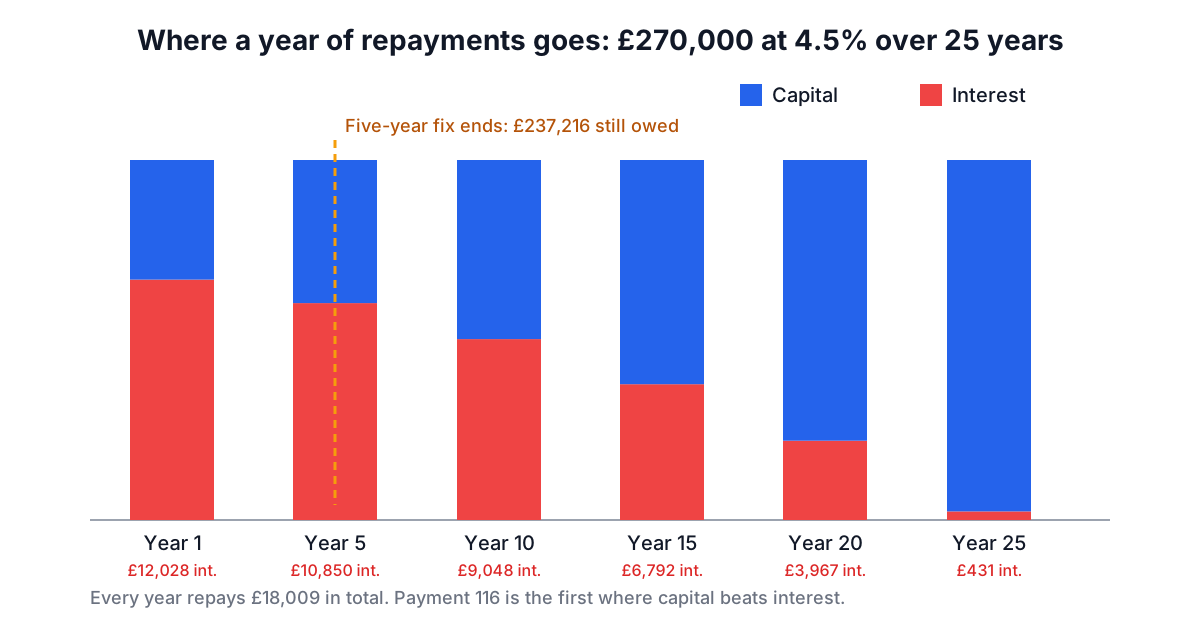
Payment 116, almost ten years in, is the first where capital outweighs interest. After two years you still owe £257,763, and after five years £237,216. Those two balances matter more in the UK than the 25-year total, because they are what you will be remortgaging when your fix ends.
Interest-only
On an interest-only mortgage the payment is just the interest: £1,012.50 a month on £270,000 at 4.5%, with the full £270,000 still owed at the end. The FCA says lenders only offer it if you have a credible way to repay the capital, and that relying on an inheritance, a bonus or house prices rising does not count.
What happens when your fix ends
When a fixed or discounted deal ends, you move to the lender's reversion rate, often its standard variable rate (SVR), unless you have arranged something new. The FCA notes the reversion rate is usually higher than the fixed rate.
Suppose the £270,000 mortgage was a two-year fix at 4.5% and the lender's SVR is 7.5%. After 24 payments you owe £257,762.54, and the repayment over the remaining 23 years jumps from £1,500.75 to £1,962.58, an extra £461.83 a month for every month you stay there. After a five-year fix the balance is £237,216.34 and the SVR payment would be £1,911.00.
The FCA says that if you are up to date with payments you should usually be able to switch to a new deal with your existing lender (a product transfer) without a new affordability check, unless you want to borrow more. Moving to a different lender normally means passing its checks again. So the end of a fix is a deadline worth putting in your diary several months ahead.
Reading the APRC on a mortgage illustration
Every regulated mortgage illustration shows an APRC, the annual percentage rate of charge. It is not the same as the headline rate, for two reasons.
- It is an annual effective rate that counts fees. Product fees and other compulsory charges are included, and monthly interest is converted to a yearly equivalent.
- It assumes you stay for the whole term. For a fix followed by a variable rate, FCA rules (MCOB 10A.3.1R(5)) take the fixed rate for the fixed period and then the lender's reversion rate as it stands today, unless that reversion rate is lower than the fix, in which case the fixed rate is assumed to continue. The FCA restated this in a June 2023 statement after many deals were priced above their reversion rates in late 2022.
Worked through for our example, with a 7.5% SVR and repayments recalculated when the fix ends:
| Deal on £270,000 over 25 years | Headline rate | APRC |
|---|---|---|
| 2-year fix, no fee | 4.5% | 7.12% |
| 2-year fix, £999 fee added to the loan | 4.5% | 7.16% |
| 2-year fix, £999 fee added to the loan | 4.19% | 7.09% |
| 5-year fix, £999 fee added to the loan | 4.3% | 6.33% |
The APRC is dominated by 23 years at the SVR that almost nobody actually pays, so it tells you little about a two-year deal. It is still useful for one thing: comparing two deals of the same length with the same lender's reversion rate. To choose between fixes, compare the cost over the fixed period instead.
Comparing two fixes properly
Take two two-year fixes on £270,000 over 25 years: Deal A at 4.19% with a £999 product fee paid up front, and Deal B at 4.49% with no fee.
| Over the two years | Deal A (4.19% + £999) | Deal B (4.49%, no fee) |
|---|---|---|
| Monthly repayment | £1,453.64 | £1,499.22 |
| Total repayments | £34,887 | £35,981 |
| Balance after 24 months | £257,234 | £257,746 |
| Interest plus fee | £23,120 | £23,727 |
Deal A wins by about £607 on this loan size. On a £120,000 mortgage the order flips: Deal A costs £10,830 over the two years and Deal B £10,545, because the rate saving is too small to cover the fee. That is why fee-free deals often suit smaller loans. Add the fee to the loan and you pay interest on it too, so treat that as a small extra cost, not a free option.
How much UK lenders will lend
UK lenders do not use the US 28/36 debt-to-income rule. They start from an income multiple and then run an affordability assessment of your income and committed spending.
- The 4.5 times line. The Bank of England's Financial Policy Committee expects no more than 15% of all new mortgage lending across the market to be at 4.5 times income or more. Since October 2026 that limit applies to the market as a whole, not to each lender. Its September 2026 record put the share of lending at high loan-to-income ratios at 14.1%, and 18.1% for first-time buyers. For most applicants 4.5 times is the ceiling and many are offered less.
- The stress test. The FPC withdrew its own interest rate stress test from 1 August 2022, but the FCA's responsible lending rules still apply: on a fix shorter than five years, the lender must check you could keep paying if rates rose. Each lender picks the rate it tests at.
On a £55,000 salary, 4.5 times income is £247,500. Add a £40,000 deposit and the highest price is £287,500. At 4.5% over 30 years that mortgage costs £1,254.05 a month. If a lender tested it at 7.5%, the payment it would check against your budget is £1,730.56, so it is the stress rate, not the multiple, that trips up applicants with large childcare costs or car finance.
Before settling on a deposit, keep the purchase taxes aside. In England and Northern Ireland, Stamp Duty Land Tax is 0% up to £125,000, 2% to £250,000 and 5% to £925,000 for a home mover, and first-time buyers pay nothing up to £300,000 and 5% from £300,001 to £500,000 (rates in force since 1 April 2025). On the £300,000 house that is £0 for a first-time buyer and £5,000 for a mover. Scotland (LBTT) and Wales (LTT) have their own bands.
Overpaying a UK mortgage
Overpayments go straight off the capital, so every pound stops costing interest for the rest of the term. On the £270,000 example:
- £200 a month extra clears the mortgage 4 years 10 months early and saves £39,155 of interest.
- A one-off £10,000 after the first year saves £18,411 and 18 months.
The catch is the early repayment charge (ERC). During a fixed or discounted deal most lenders let you overpay up to an allowance set out in your mortgage offer without a charge; above it, the FCA says an ERC is typically a percentage of the balance that falls as the deal nears its end, and some lenders charge none. Check the allowance before setting up a standing order, and check whether your lender reduces the monthly payment or the term after an overpayment; shortening the term saves more interest.
If you also hold credit card or personal loan debt at a higher rate, clearing that first usually beats overpaying a mortgage at 4% to 5%.
Remortgaging and the break-even month
UK remortgages come in two kinds, and they need different sums.
Moving off the reversion rate. With £180,000 left over 22 years, going from a 7.5% SVR to a 4.3% fix with a £999 fee added to the loan cuts the repayment from £1,394.12 to £1,061.42, a saving of £332.70 a month. The fee is recovered by month 3. Here the only real question is how quickly you can arrange it.
Leaving a fix early. Moving the same £180,000 from a 5.6% fix to a 4.2% deal with a 3% ERC (£5,400) plus the £999 fee, paid up front, saves £141.59 a month. Costs divided by savings suggests 46 months. Counting the faster fall in the balance at the lower rate, as the Remortgage Calculator does, the switch breaks even in month 31. If the new deal is a two-year fix, it would not have paid for itself before that deal ended, so waiting for the ERC to fall or expire is usually better.
A checklist before you sign
- Reproduce the illustration's monthly payment from the loan, rate and term.
- Write down the date the fix ends, the balance you will owe then, and the reversion rate.
- Compare deals by interest plus fees over the fixed period, not by headline rate or APRC alone.
- Check the payment at a rate two or three points higher and against your take-home pay.
- Find the annual overpayment allowance and the ERC schedule in the offer.
- Budget separately for Stamp Duty (or LBTT or LTT), conveyancing, the survey and buildings insurance.
If you are still deciding whether to buy at all, the UK rent or buy guide and the Rent or Buy Calculator compare the two by what you own after a given number of years.
Frequently asked questions
Why is the APRC on my mortgage so much higher than the rate?
Because it assumes you keep the mortgage for the whole term. After the fixed period it applies the lender's current reversion rate, usually its standard variable rate, unless that is lower than the fix. A two-year fix at 4.5% on £270,000 with a 7.5% SVR has an APRC of 7.12%, even though you would normally remortgage before paying the SVR.
What happens to my payments when my fixed rate ends?
You move to your lender's reversion rate unless you arrange a new deal. On a £270,000 mortgage at 4.5% over 25 years, moving to a 7.5% SVR after two years raises the repayment from £1,500.75 to £1,962.58 a month. A product transfer with your existing lender usually needs no new affordability check if you do not borrow more.
Is a deal with a fee cheaper than a fee-free deal?
It depends on the loan size. On £270,000 over two years, a 4.19% fix with a £999 fee costs £23,120 in interest and fees against £23,727 for a 4.49% fix with no fee. On a £120,000 mortgage the same two deals cost £10,830 and £10,545, so the fee-free deal wins.
How much can I borrow on a £55,000 salary?
Most lenders cap borrowing at about 4.5 times income, so up to roughly £247,500, and the affordability assessment can bring that down. With a £40,000 deposit the highest price would be £287,500, and the repayment at 4.5% over 30 years would be £1,254.05 a month.
Should I remortgage before my fix ends?
Only if the saving recovers the early repayment charge and fees before the new deal ends. Leaving a 5.6% fix for 4.2% on £180,000 with £6,399 of costs breaks even in month 31, longer than a two-year fix. Most borrowers do better securing a new deal a few months ahead and switching on the day the old one ends.
Sources and further reading
- Support available for mortgages as interest rates rise, Financial Conduct Authority. Reversion rates, ERCs, switching with your lender, the stress test on fixes under five years and interest-only.
- Annual Percentage Rate of Charge (APRC) calculations, Financial Conduct Authority. How the APRC treats a reversion rate lower than the fix.
- MCOB 10A: Annual percentage rate of charge, FCA Handbook. The APRC formula and assumptions, including MCOB 10A.3.1R(5).
- FG26/11: High loan-to-income lending, Financial Conduct Authority. The 15% limit on lending at 4.5 times income as a market-wide limit from 14 October 2026.
- High loan-to-income lending: policy statement PS19/26, Prudential Regulation Authority. Removal of the firm-level cap.
- FPC's mortgage market recommendation, Financial Conduct Authority. The end of the FPC affordability test.
- Financial Policy Committee Record, September 2026, Bank of England. Share of lending at high loan-to-income ratios.
- Stamp Duty Land Tax: residential property rates, GOV.UK. Standard bands and first-time buyer relief.
More Loans & Mortgages
Every tool in the Loans & Mortgages section, free and in your browser.