
How Mortgages Work in Canada: Payments, CMHC, Renewal
How Canadian mortgage payments are worked out with semi-annual compounding, what CMHC insurance costs, how the stress test sets your budget, and renewal or breaking.
By Redbison Dev · · 10 min read
Canada edition. Written for Canadian buyers: CA$, fixed rates compounded semi-annually, terms and renewals, CMHC premiums, the stress test with GDS and TDS, prepayment penalties and the FHSA. US edition
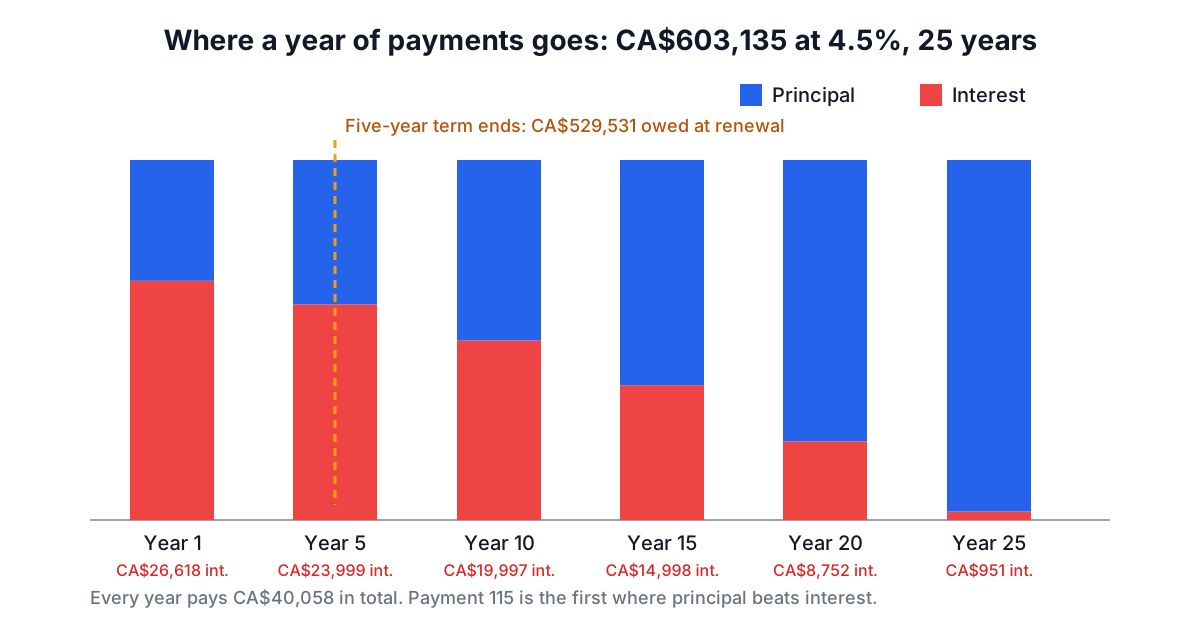
A CA$650,000 home bought with 10% down in Canada needs a CA$603,135 mortgage once the CMHC insurance premium is added. At a 4.5% five-year fixed rate over a 25-year amortization the payment is CA$3,338.19 a month. After those five years you will have paid CA$200,291, of which CA$126,687 was interest, and you will still owe CA$529,531 when the term comes up for renewal at whatever rate the market offers then.
Those three numbers, the premium, the semi-annual payment and the renewal balance, are where Canadian mortgages differ most from the US loans most online guides describe. This guide works through each one with the Canadian Mortgage Calculator, the Mortgage Affordability Calculator, the Mortgage Refinance and Renewal Calculator and the APR and Cost of Borrowing Calculator. It explains the math and the federal rules; it is not advice on a specific mortgage, and a licensed mortgage professional can look at your full situation.
Term and amortization are different things
A Canadian mortgage has two clocks:
- Amortization is how long it would take to repay the whole loan at the current payment, usually 25 years, or up to 30 for some buyers.
- Term is how long your rate and conditions are locked, most often five years. At the end of the term you renew, with your lender or another one, at the rate of the day.
So nobody really borrows "at 4.5% for 25 years". You borrow at 4.5% for five years and then reprice four more times. The balance at each renewal matters as much as the payment.
How the payment is worked out
The Interest Act requires a blended-payment mortgage to state its rate "calculated yearly or half-yearly, not in advance", and fixed-rate lenders quote it compounded half-yearly (semi-annually). The monthly rate is therefore not 4.5% ÷ 12 but:
monthly rate j = (1 + 0.045 / 2)^(2/12) − 1 = 0.3715% (4.4584% compounded monthly)

payment = L × j × (1 + j)^n / ((1 + j)^n − 1)
L = CA$603,135   n = 300 payments
payment = CA$3,338.19
A US calculator compounding monthly at the same 4.5% would show CA$3,352.42, about CA$14 more. Many variable-rate products compound monthly instead; check the contract and switch the compounding setting if so.
In month one, interest is CA$2,240.84 and only CA$1,097.35 reduces the balance. Payment 115, in year 10, is the first where principal outweighs interest.
CMHC insurance instead of PMI
With less than 20% down, a mortgage from a federally regulated lender must carry mortgage default insurance, from CMHC or a private insurer. Unlike US PMI, it is a one-time premium on the loan, usually added to the mortgage rather than paid monthly, and it never comes off.
| Loan-to-value | CMHC premium (standard) |
|---|---|
| 80.01% to 85% | 2.80% |
| 85.01% to 90% | 3.10% |
| 90.01% to 95% | 4.00% |
A 30-year insured amortization adds 0.20 points. In Quebec, Ontario and Saskatchewan, provincial sales tax applies to the premium and must be paid in cash at closing; it cannot be added to the loan.
The minimum down payment is 5% of the first CA$500,000, 10% of the portion from CA$500,000 to CA$1.5 million, and 20% from CA$1.5 million (the cap on insured mortgages rose from CA$1 million to CA$1.5 million on December 15, 2024). On CA$650,000 that is CA$25,000 plus CA$15,000, or CA$40,000.
First-time buyers and 30-year amortizations
Insured first-time buyers and buyers of new builds can amortize over 30 years; everyone else under 20% down is limited to 25. Take a CA$480,000 home with the 5% minimum (CA$24,000):
| 25 years | 30 years | |
|---|---|---|
| Premium | 4.00% = CA$18,240 | 4.20% = CA$19,152 |
| Mortgage | CA$474,240 | CA$475,152 |
| Monthly payment | CA$2,624.79 | CA$2,395.79 |
| Interest over the amortization at 4.5% | CA$313,197 | CA$387,333 |
The longer amortization lowers the payment by CA$229 a month but adds CA$912 of premium and about CA$74,100 of interest if the rate never changed. It is a qualification tool, not a free saving.
Two registered plans help with the down payment. A First Home Savings Account (FHSA) takes up to CA$8,000 a year, to a CA$40,000 lifetime limit, with a deduction on the way in and no tax on a qualifying withdrawal. The Home Buyers' Plan lets you withdraw up to CA$60,000 from your RRSPs, to be repaid over time, and you can use both for the same home.
How much you can borrow: the stress test, GDS and TDS
Canadian lenders do not use the US 28/36 rule. CMHC caps two debt service ratios:
- GDS (gross debt service): principal, interest, property tax, heating and half of any condo fees, as a share of gross income. Limit 39%.
- TDS (total debt service): GDS plus all other debt payments. Limit 44%.
Both are measured at the stress-test rate: the higher of 5.25% or your contract rate plus 2 points, for insured and uninsured mortgages with federally regulated lenders.
A household earning CA$140,000 with CA$600 a month of car payments and CA$80,000 saved, at a 4.5% contract rate, 0.8% property tax and CA$120 a month of heating, qualifies at 6.5%. The affordability calculator puts the maximum price at about CA$655,764, with a CA$593,612 mortgage including a CA$17,849 premium. The payment the lender tests is CA$3,976.16, but the payment you would actually make is CA$3,285.48. TDS binds at 44.0%, with GDS at 38.9%. Paying off the car loan barely helps here, because GDS sits right at its 39% limit too: the maximum rises only to about CA$657,965.
Paying faster: accelerated bi-weekly
Canadian lenders offer several payment frequencies, and the names hide a real difference:
| Frequency on CA$603,135 | Payment | Paid off in | Interest saved |
|---|---|---|---|
| Monthly | CA$3,338.19 | 25.0 years | none |
| Bi-weekly (monthly × 12 ÷ 26) | CA$1,540.70 | 25.0 years | CA$1,833 |
| Accelerated bi-weekly (monthly ÷ 2) | CA$1,669.09 | 21.7 years | CA$60,408 |
| Accelerated weekly (monthly ÷ 4) | CA$834.55 | 21.7 years | CA$61,086 |
Accelerated payments add up to 13 monthly payments a year instead of 12, and the extra goes straight to principal. Most closed mortgages also allow lump-sum prepayments and payment increases each year up to a limit in the contract; above it, a penalty applies.
Renewal: the payment can jump
At the end of the five-year term the CA$529,531 balance has 20 years of amortization left. The renewal rate sets the new payment:
| Renewal rate (semi-annual) | New monthly payment | Change |
|---|---|---|
| 3.5% | CA$3,064.20 | −CA$273.99 |
| 4.5% | CA$3,338.19 | none |
| 5.5% | CA$3,624.06 | +CA$285.87 |
| 6.5% | CA$3,921.18 | +CA$582.99 |
Shop the renewal. At the end of a term there is no penalty for moving, and since November 21, 2024 OSFI has exempted uninsured straight switches from the stress test when the loan amount and amortization do not increase; insured switches were already exempt. With CA$380,000 owing over 20 years, moving from a 4.89% renewal offer to 4.39% elsewhere saves CA$101.07 a month and recovers CA$1,200 of switching costs by month 8.
Breaking a mortgage early
Breaking a closed mortgage during the term usually costs the higher of three months of interest and the interest rate differential (IRD). FCAC's own example: on a CA$200,000 balance at 6% with 36 months left, three months of interest is about CA$3,000 and the IRD about CA$12,000, so the penalty is CA$12,000.
Suppose you owe CA$420,000 at 5.49% with 21 years left and can get 4.29%. Three months of interest alone is CA$5,764.50; say the lender quotes an IRD of CA$9,000, plus CA$1,500 of legal and appraisal costs. The payment falls from CA$2,796.68 to CA$2,522.86, saving CA$273.82 a month. Dividing CA$10,500 by that saving suggests 39 months, but counting the faster paydown at the lower rate the refinance calculator finds break-even in month 26. If more than 26 months remain on the new term, breaking pays. Refinancing to borrow more means passing the stress test again.
APR on a Canadian mortgage
Your disclosure statement shows an APR alongside the interest rate. Under the Financial Consumer Protection Framework Regulations, the cost of borrowing behind that APR includes interest and charges such as required legal fees, appraisals and broker fees paid through the lender, but excludes mortgage default insurance premiums, registration fees and prepayment penalties. So a CMHC premium does not raise the APR, and with no other fees the APR equals the interest rate. The APR calculator shows how fees change it.
Before you sign
- Reproduce the payment using semi-annual compounding.
- Note the balance you will owe at renewal and test the payment at a rate two points higher.
- Add the CMHC premium, and the provincial sales tax on it where it applies.
- Check GDS and TDS at the stress-test rate, then against your take-home pay.
- Read the prepayment privileges and the penalty clause, including how the IRD is calculated.
- Budget for land transfer tax, legal fees and the home inspection.
If you are still deciding whether to buy, the Canadian rent or buy guide and the Rent or Buy Calculator compare the two by net worth.
Frequently asked questions
What is the difference between a mortgage term and an amortization?
The term is how long your rate and conditions are locked, often five years; the amortization is how long it would take to repay the whole loan, usually 25 or 30 years. At the end of each term you renew at the rate of the day. On a CA$603,135 mortgage at 4.5%, CA$529,531 is still owed when a five-year term ends.
How much is CMHC insurance on a 10% down payment?
With 10% down the loan-to-value is 90%, so the standard premium is 3.10% of the loan. On a CA$650,000 home that is CA$18,135 on a CA$585,000 loan, usually added to the mortgage. A 30-year insured amortization adds 0.20 points, and Quebec, Ontario and Saskatchewan charge provincial sales tax on the premium.
What rate is used for the mortgage stress test?
The higher of 5.25% or your contract rate plus 2 points. At a 4.5% contract rate you qualify at 6.5%, and GDS must stay at or under 39% and TDS at or under 44% of gross income at that rate. The payment you actually make is still based on 4.5%.
How much will my payment go up at renewal?
It depends on the renewal rate and the balance left. A CA$529,531 balance with 20 years to go costs CA$3,338.19 a month at 4.5%, CA$3,624.06 at 5.5% and CA$3,921.18 at 6.5%, both semi-annually compounded. Shopping other lenders at renewal carries no penalty.
Are accelerated bi-weekly payments worth it?
They shorten the amortization because they add up to one extra monthly payment a year. On CA$603,135 at 4.5% they clear the loan in about 21.7 years instead of 25 and save about CA$60,400 of interest. Plain bi-weekly payments, worked out as monthly × 12 ÷ 26, save almost nothing.
Sources and further reading
- Interest Act, section 6, Justice Laws Website, Government of Canada. Rates on blended-payment mortgages stated yearly or half-yearly.
- CMHC mortgage loan insurance cost, Canada Mortgage and Housing Corporation. Premium table and provincial sales tax on premiums.
- CMHC revises homeowner mortgage loan insurance premiums, Canada Mortgage and Housing Corporation. The 0.20-point surcharge for amortizations over 25 years.
- Saving for a down payment, Financial Consumer Agency of Canada. Minimum down payment by price.
- Boldest mortgage reforms in decades come into force today, Department of Finance Canada. CA$1.5 million insured mortgage cap and 30-year amortizations.
- Preparing to get a mortgage, Financial Consumer Agency of Canada. The stress test qualifying rate.
- Calculating GDS / TDS, Canada Mortgage and Housing Corporation. The 39% and 44% limits and what each ratio counts.
- Mortgage prepayment penalties, Financial Consumer Agency of Canada. Three months of interest and the IRD.
- OSFI exempts uninsured mortgage straight switches from prescribed MQR, Office of the Superintendent of Financial Institutions.
- Make the most of your first home savings account, Canada Revenue Agency. FHSA limits.
- The Home Buyers' Plan, Canada Revenue Agency. The CA$60,000 withdrawal limit.
More Loans & Mortgages
Every tool in the Loans & Mortgages section, free and in your browser.